

- September 22, 2026
- Becky Seefeldt
- 0
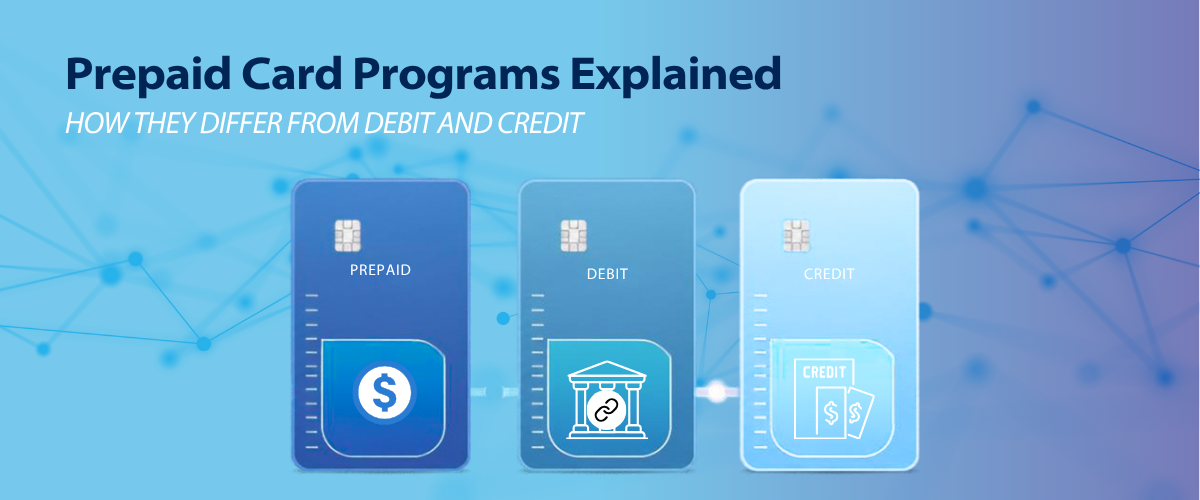
Prepaid Card Programs Explained: How they differ from debit and credit
Prepaid card programs, debit programs, and credit programs can look identical at the point-of-sale. The difference typically sits behind the card. It is determined in part by the funding source, the account structure, and the party that holds liability for the balance. Understanding these factors helps program sponsors, issuers, and compliance teams classify a program correctly and design it with the right controls from the start.
This post explains how prepaid card programs differ from debit and credit, and what determines where a program falls.
What Is a Prepaid Card Program?
A prepaid card program is an arrangement in which funds are loaded in advance and held as stored value. Each transaction reduces the available balance. No credit is extended, and the card does not require a linked personal deposit account to function.
Prepaid programs typically involve an issuing bank, a BIN sponsor, a program manager, and a processor. Each party has defined responsibilities for funds handling, compliance, and transaction processing.
Prepaid vs Debit vs Credit: Core Differences
A card is an access instrument. The program type is defined by the arrangement behind it.
| Prepaid | Debit | Credit | |
|---|---|---|---|
| Source of funds | Stored value loaded in advance | Balance in a deposit account | Revolving line of credit |
| Underwriting | No individual credit decision; identity verification may apply | Account opening and identity verification required | Identity verification and credit underwriting applies |
| Repayment | Varies; full payment due at settlement; balance may be pre-funded or funded based on usage | None; funds are drawn from the account | Cardholder repays the issuer |
| Balance liability | Held according to program structure | Deposit held by a financial institution | Issuer extends credit and carries exposure |
| Primary regulatory frameworks | Regulation E where applicable, including prepaid account rules | Regulation E | Regulation Z and the Truth in Lending Act |
Interchange treatment varies by issuer type and program structure, and should be reviewed for each program. It is possible the same card design can sit in different categories depending on the answers to these questions.
Why Card Program Classification Matters
Program type affects:
- Compliance obligations. Onboarding requirements, disclosures, dispute handling, and consumer protection rules vary by model.
- Issuer and sponsor requirements. Different structures involve different bank and program manager relationships.
- Interchange treatment. Fee economics depend on issuer type and program structure.
- Technical integration. Ledgering, authorization logic, and settlement flows differ across models.
Classifying a program correctly early in design reduces rework later.
Use Case Examples and the Core Considerations
Open Loop and Closed Loop Prepaid Programs
Open loop programs carry a card network brand and can be used wherever that network is accepted, subject to program level restrictions.
Closed loop programs are usable only within a defined merchant or ecosystem.
Both models rely on stored value. The loop type describes where the card can be used. It does not change whether the program is prepaid.
Benefits Programs as Prepaid Card Programs
Benefits prepaid card programs, such as FSAs, wellness stipends, and flexible allotments, are typically structured as prepaid. Several characteristics explain why:
- Funds are provided in advance. The plan sponsor funds or guarantees the balance before the member spends it, which matches the stored value model.
- No credit decision is involved. The member is not borrowing. The balance is an allocation, so no underwriting takes place.
- Balances are often divided into purses. A single card may carry multiple balances, each with its own eligible categories, amounts, and expiration rules. Stored value ledgers support this kind of segmentation.
- Spend rules operate at the balance level. Merchant category restrictions and item level eligibility controls are applied against a specific balance at authorization.
Program design and legal structure still govern the final classification. Any specific benefits program should be reviewed against its issuer agreements and applicable regulations. For related reading, see How a Smart Benefits Card knows which account to use.
HSA Programs: Debit Only or a Purse on a Multi-Purse Prepaid Card
An HSA card can be offered in two structures. It can operate as an HSA-only debit program, or as one purse on a multi-purse capable prepaid card program. In both cases, the card is an access point to the HSA, not the account itself.
A health savings account (HSA) is a deposit account held by an authorized custodian. The HSA remains subject to Regulation E and other deposit account requirements, regardless of the card structure used to reach it.
- HSA only debit program: The card accesses only the HSA, drawing on a funded balance in the custodian’s deposit account. This aligns with the debit model.
- HSA as a purse on a multi purse prepaid card: One card carries several balances, and the HSA is one of them. Prepaid purses hold stored value in the program ledger, while the HSA purse routes eligible transactions to the custodian held account.
The regulatory treatment follows the account, not the card. Classification of HSA, FSA, and HRA arrangements should be confirmed with compliance.
Private-Label Prepaid Programs and Balance Liability
A private label balance sheet prepaid card program can align with the prepaid model when a third-party holds the balance liability rather than a card network.
In a private label balance sheet program, the card operates within a defined merchant or ecosystem instead of as a broadly accepted network branded card. The relevant question is who holds the obligation for the balance. When value is funded in advance and the liability sits with the program sponsor or another third party, the structure aligns with stored value.
Private label is not automatically prepaid and specific program considerations may affect the final classification.
Classification Starts with Structure
Prepaid, debit, and credit card programs share essentially the same network rails and similar checkout experience. Their differences sit in the arrangement behind the card: the source of funds, the party that holds the balance, and the regulatory framework that follows.
For program sponsors, this makes classification a design decision, not a label applied after launch. Mapping each balance to its funding source and liability early supports clearer compliance planning, cleaner ledgering, and more accurate issuer and sponsor conversations.
Teams evaluating card program infrastructure can review Xformative Solutions for more on supported program models, request a consultation for a specific program.
FAQs
A prepaid card program is an arrangement in which funds are loaded before use and held as stored value. Spending reduces the balance, and no credit is extended.
On the surface, both cards may look the same and even both process through the network debit rails. However, a debit card directly draws on funds in a linked deposit account. A prepaid card draws on a stored value balance managed within the program.
A credit card draws on a revolving line of credit extended by the issuer. A prepaid card uses funds supplied in advance and involves no borrowing.
Benefits programs typically fund balances in advance, avoid credit underwriting, and need to divide balances into categories with specific spend rules. Stored value programs support all three requirements.
It can, when the balance is funded in advance and the liability is held by a third party. If the program extends a line of credit, it functions as credit.
Source of funds, account structure, liability, underwriting, issuer and sponsor model, and applicable regulation.
