

- September 3, 2026
- Becky Seefeldt
- 0
How to Choose the Right Payment Processor as a Fintech Startup: 7 Key Criteria
Key Takeaways
- Most processor comparisons are built for retail merchants selling physical goods, not for fintechs issuing cards, managing ledgers, or running multi-purse programs.
- The real decision is not gateway versus processor. It is whether a platform supports card issuance, ledger infrastructure, and program-level rules from day one.
- Fee transparency, integration depth, and time to launch tend to get the early attention, but compliance, risk mitigation, and scalability are what founders most often underweight, and where late-stage pain tends to originate.
Most guides on choosing a payment processor are written for merchants selling physical goods. They compare transaction fees for retail checkout, walk through point-of-sale hardware, and provide a list of features. For a fintech founder or product lead, it can send product architecture down the wrong path and waste valuable planning and technical cycles.
The wrong processor does more than increase your investment expense. It can cap what you can build, slow onboarding, and limit your roadmap. A processor that performs well in one business model may be a poor fit in another. Every use case carries its own operational, compliance, and technical requirements.
Gateway, Processor, or Platform
A payment gateway transmits card data from a customer to a processor. A payment processor moves money between a customer’s bank and a business account. Most comparisons treat these as the same thing, which leads founders to evaluate tools at the wrong layer. What many fintech startups actually need is not just a gateway or a processor. It is a platform: card issuance, ledger infrastructure, authorization logic, and API depth to build on top of.
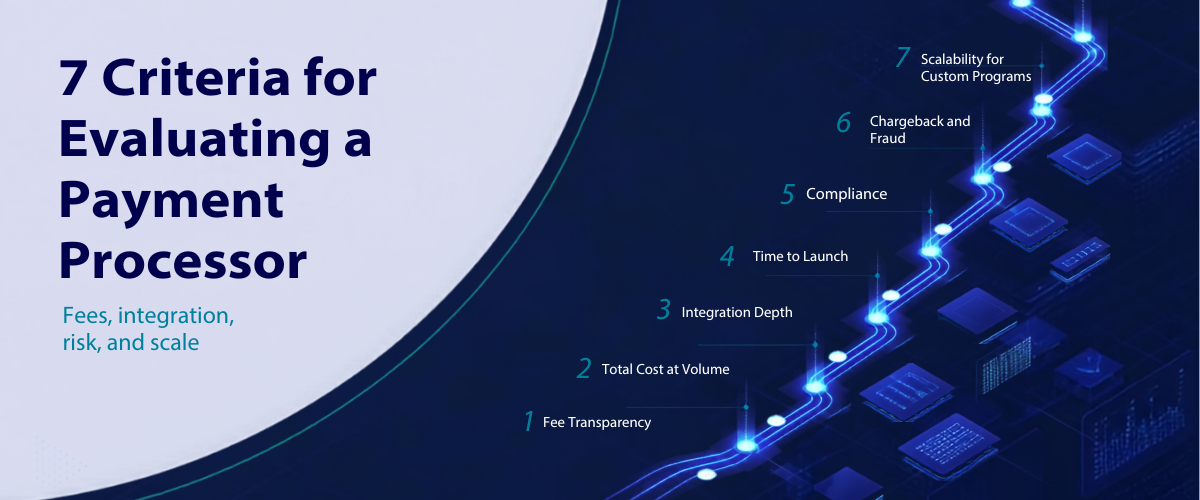
Use the seven criteria below to evaluate any candidate before you sign.
1. Fee Transparency
Pricing for payment solutions can vary widely. A flat-rate structure is predictable early on but tends to become expensive at volume. Tiered-per-account and interchange-based pricing are typically more transparent and cost-effective as volume grows. Ask for a complete fee schedule in writing. Make sure you understand any usage or add-on fees, especially any that are core to your desired solution. Per-use fees for APIs, SMS, notification triggers, reporting, etc. can erode your margins if not understood clearly.
2. Total Cost at Projected Volume
Chargeback fees, monthly minimums, PCI compliance fees, statement fees, fraud monitoring, and early termination penalties rarely show up on a simple pricing page. But, they can add up quickly depending on your vertical and business solution. Determine your total cost against your actual volume today. And, estimate where you expect to be in twelve to eighteen months.
3. Integration Depth
Often, a payment solution is a one-size fits all platform. The initial engineering lift may be minimal, but it also limits control over the payment experience and the data flow. A full API integration gives you control. The build-out can range from a couple of weeks for straightforward use cases to several months for complex programs. If it’s difficult to get a clear view of the API before committing, that may indicate how challenging it will be to get answers or support once you’re live.
4. Time to Launch
The hardest part of evaluating a processor isn’t the feature set; it’s understanding how much of the integration burden you’ll actually carry. If documentation is unclear, sandbox access is restricted, webhook behavior is unpredictable, or support is slow to respond, even simple builds stretch into long, painful projects. It’s worth pushing for sandbox credentials early, reviewing documentation or even engaging with their technical teams before you sign. Those signals tell you far more about real‑world integration speed than any sales demo.
5. Compliance and Underwriting Requirements
PCI DSS compliance is mandatory regardless of the processor, but your scope depends on how card data gets handled in your systems. KYC and AML requirements escalate quickly for any business that moves money, holds funds, or onboards sub‑merchants. Processors (on behalf of the bank sponsor) will often require incorporation records, beneficial ownership details, and a formal compliance policy before granting production access. Understanding the process and documentation requirements early speeds up due diligence processes.
6. Chargeback and Fraud Mitigation
Fintech startups often face strict risk controls from processors or the sponsor bank, and rolling reserves are among the biggest. Processors frequently hold a percentage of funds to ensure card funding is available for settlement. Ask directly what triggers a reserve, what percentage applies, and how it is adjusted. Also ask what dispute-alert systems and fraud-scoring tools the processor provides to reduce exposure.
7. Scalability for Custom Programs
Many platforms handle a simple flow well: charge a card, process a refund, settle funds. The process works until your product requires a multi-purse card with category-level spending rules, a real-time ledger, or program-specific configurations that need to scale without a re-architecture at your next funding round. At that point, a generic processor does not just get more expensive. It becomes a product blocker.
Xformative centers on these seven criteria, offering flexible processing, real‑time ledgering, and configurable rules. Multi‑purse structures and spend controls are built into the architecture, not added later.
Evaluating a processor starts with understanding how each one performs across the seven criteria and how those needs shift as you grow. Compliance, risk controls, and scalability are often underweighted early, and they’re usually where problems surface later. Get all the material terms (fees, reserve policies, and onboarding timelines) in writing before you commit.
