


- June 10, 2026
- Becky Seefeldt
- 0
What Is Ledger as a Service, and Do You Need It for Fintech?
Most fintech discovery conversations start with card processing. The ask is simple: issue cards, authorize transactions, settle funds. To the untrained eye, that feels like the complete picture, and for some products, it is.
Most people are familiar with simple balance recordkeeping: a single account, one funding source, straightforward debits and credits. That linear flow works. It is also the reason the ledger (or the need for one) often goes unrecognized at first. When nothing in the product requires tracking value across multiple sources, purses, or rule sets, there is no obvious gap. The complexity is not visible until the product requires something more.
The Shift
As Products Gets More Complex, the Role of the Ledger Takes Shape
The moment a fintech product involves multiple funding sources, restricted spend categories, compliance‑driven benefits accounts, or mixed employer and employee funds, the requirements change. Add rewards, points, buy now pay later arrangements, or any form of programmatic spend control, and those requirements shift even more dramatically.
Card processing answers one question: should this transaction be approved?
The ledger answers a different set of questions:
What happened to the funds? Which account did they come from? Was the account pre-funded or funded on usage? What rules applied? Where do balances stand right now?
For products with a single balance and no spend restrictions, those questions are simple enough that basic processing handles them. For products that need to govern value movement across multiple parties, accounts, or rule sets, those questions require a dedicated system built to answer them correctly, in real time, at every transaction.
Understanding the Basics of a Ledger
What a Ledger Actually Is
A ledger is the system of record for value movement. Not just transaction history, but value. Every debit, credit, hold, adjustment, purse-level rule, and balance update flows through it. In modern payments infrastructure, the ledger is not an end-of-day accounting report. It is a real-time engine that keeps every participant in the system operating from the same source of truth.
Programmable ledgers extend this further. They track balances across multiple purses, enforce entity-level rules, support non-monetary values like points or credits alongside dollars, and handle reversals and returns back to the originating account. That level of precision is the mechanism that makes regulated and multi-party products work correctly.
Who Actually Needs It
Benefits platforms, health account administrators, employer‑sponsored spend programs, B2B platforms with category‑controlled cards, and any fintech moving value across multiple parties all rely on the ledger as core infrastructure. The same is true for structured disbursement programs, loyalty ecosystems with multiple value types, or any product where a cardholder has more than one bucket of funds governed by different rules.
The common thread is not industry. It is whether the product needs to control funds, not just move them.
The Real Cost of Not Having It
The cost of inadequate ledger infrastructure rarely shows up at launch. It appears under volume, during audits, and when edge cases start to stack up.
When ledger accuracy slips, balances lag. A member spends from a benefits purse, yet the available balance doesn’t update before the next transaction. In regulated programs, that isn’t a minor inconvenience. It’s a compliance and risk exposure. Missing purse‑level tracking creates similar problems: a multi‑benefit card can’t reliably determine which account funded a transaction, leading to substantiation gaps and plan‑governance risk.
If auditability isn’t built into the ledger layer, reconciliation turns into manual work. Reversals, returns, and adjustments must be traced backward through logs instead of surfaced through a structured system of record. At scale, that labor cost is substantial. and the risk is even greater in regulated industries.
Teams that underestimate this usually discover the gap when volume grows, when an audit arrives, or when a new program requirement reveals that the system can’t enforce a rule everyone assumed it could.
What Ledger-as-a-Service Provides
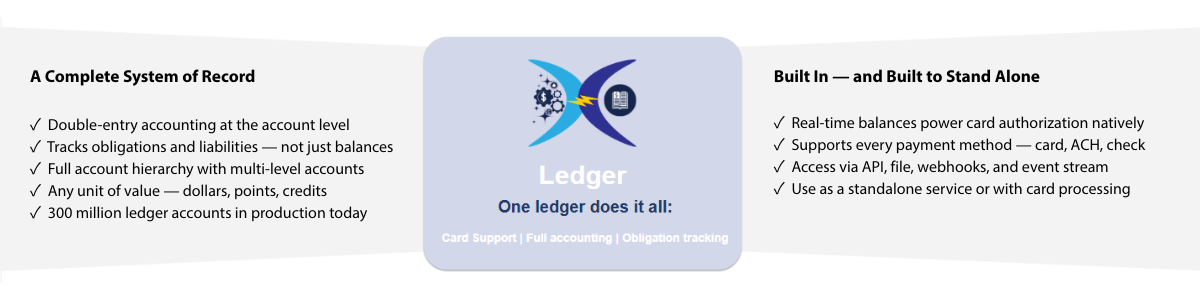
Ledger-as-a-service means accessing programmable ledger infrastructure through an API rather than building and maintaining it internally. It covers account management, entries, posting fund flows, real-time balance updates, multi-purse architecture, custom rules logic, and reconciliation tooling — connected directly to card processing and payment operations.
The practical outcome is that a fintech product can enforce complex spend controls, maintain accurate balances across multiple value types, support compliance reporting, and handle reversals and adjustments correctly — without building the underlying engine from scratch.
Where Xformative Fits
Xformative provides ledger-as-a-service as a core component of its payments infrastructure. The Ledger API manages accounts, entries, and fund flows. It supports multi-purse architectures, real-time balances, custom rules and process flows, and reconciliation tooling. It handles monetary and non-monetary values within the same framework. Proven fund flows are available out of the box, and custom flows are supported for programs with requirements that fall outside standard patterns.
For fintech products that need real-time ledger infrastructure without the engineering overhead of building it internally, Xformative’s modular, API-first design means the ledger layer integrates alongside card processing from the start. It is not an afterthought when the product has already outgrown what basic processing can track.
Card processing is where the conversation usually begins. Whether a ledger is needed depends on what the product actually has to do.
Built for Payment Complexity
Xformative is purpose-built for programs that require fund governance across multiple parties, locations, and payment types.
