

- August 5, 2026
- Becky Seefeldt
- 0
How Long Does It Take to Onboard With a New Payment Processing Platform?
Key takeaways
- Payment processor onboarding timelines range from days to more than a year, driven by two factors: the age of the technology and the actual complexity of the program.
- Every payment program moves through the same core stages: compliance review, BIN sponsorship, network approval, API integration, testing, and go live.
- Most complex programs are not purely legacy or purely modern. The technical build may take days while sponsor and network approvals still take weeks in parallel.
- A program manager, positioned between sponsor compliance requirements and the technical build, keeps these tracks moving together instead of stalling in sequence.
- The right question for evaluating a platform is not how fast onboarding is overall, but which parts of the timeline the platform actually controls.
There is no single answer to this question, and any vendor who gives you one number is oversimplifying. Onboarding with a payment processor can take anywhere from a few days to more than a year. The gap comes down to two variables that get conflated far too often: the age of the underlying technology, and the actual complexity of the payment program being built.
A basic card acceptance integration on a modern platform can go live in days. A multi purse benefits program, an embedded lending product, or anything that touches a sponsor bank’s balance sheet is a different undertaking entirely, regardless of how modern the processor’s API is. Understanding why requires breaking onboarding into its actual stages, not just labeling a platform “legacy” or “modern” and assuming that settles the timeline.
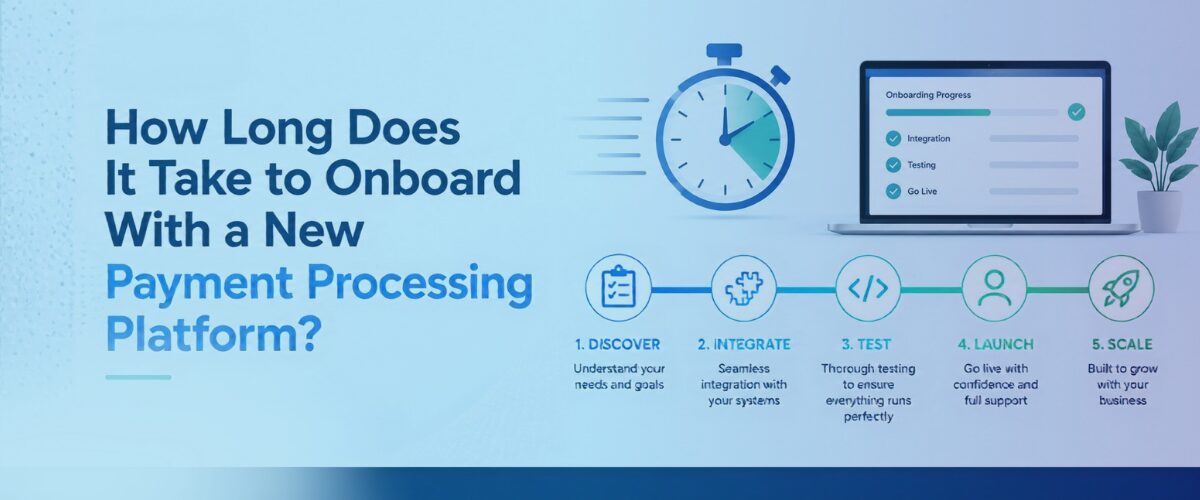
What are the steps to onboarding a payment processor?
Nearly every payment onboarding process, old or new, moves through some version of the following:
Compliance review
This covers know your business (KYB) and know your customer (KYC) checks, anti money laundering (AML) screening, and PCI DSS scoping. Documentation requirements vary by risk profile, and incomplete submissions are the single biggest source of delay. A clean first pass can shave two to three weeks off a review that would otherwise stretch across multiple rounds of follow up requests.
BIN sponsorship and bank sponsor program approval
Any program that issues cards needs a sponsor bank that will approve the program itself. The sponsor evaluates the program’s risk profile, funds flow, and controls before agreeing to extend its BIN.
Card network approval
Visa, Mastercard, and other networks require their own review of a program before it can go live under their network. This can mean full network membership or approval to operate under a sponsor’s existing BIN range.
API integration and technical build
This is the actual development work: connecting authorization, settlement, ledgering, and reporting systems to the processor’s platform. This is the area that modern payment processors tend to vary from legacy processors.
Testing and certification
Sandbox testing, network certification, and user acceptance testing confirm the integration behaves correctly under real transaction conditions before it touches live funds.
Go live and monitoring
Even after launch, most programs run a monitoring period before scaling volume.
Every one of these stages exists on both legacy and modern platforms. What changes is how much time each one consumes and how much of it can run in parallel.
What are key onboarding differences between legacy platforms and modern payments processors?
Legacy platforms
On legacy infrastructure, the onboarding stages tend to run sequentially, and require resource allocation at each stage. Manual document review, custom coding for even minor changes, and rigid batch based processing all add friction. Launching a new financial product on a legacy core can take six months to well over a year. Simple changes such as adding a payment rail or adjusting program terms may be out-of-scope or require a separate project and timeline.
This is not a slight on any specific vendor. It reflects how these systems were architected decades ago, for a world where programs changed infrequently and integration partners were few. The cost shows up in market timing and product flexibility.
Modern cloud native platforms
Cloud native, API first platforms compress the technical layer of onboarding substantially. Integrated compliance checks, standardized integration patterns, and infrastructure that does not require custom code for routine configuration changes all shorten the build and test stages.
That said, “modern” only compresses what modern infrastructure controls: the integration, the configuration, and the testing cycle. It does not compress underwriting decisions made by a third party sponsor bank or approval timelines set by a card network. Those stages run on their own clocks no matter how fast the API is.
Why most programs are not purely one or the other?
This is the part that gets lost in “legacy versus modern” framing. BIN setup, network approvals, and bank sponsor underwriting are foundational gatekeeping steps in both worlds. A program manager relationship with a sponsor bank, a networks’s review of a new BIN range, a program’s risk assessment: none of that disappears because the processor sitting on top of it runs on modern infrastructure.
In practice, most complex payment programs sit somewhere in between. The technical integration might take days on a well-designed API. The sponsor bank underwriting and network approval running alongside it can still take weeks, because those decisions belong to regulated financial institutions and card networks, not to the processor. A realistic timeline adds these tracks together rather than assuming the fastest one sets the pace for the whole program.
Where a program manager fits in
This is where the program manager role earns its place. A program manager operates under the sponsor bank’s BIN and the card network’s rules, but owns the design of the program, the customer experience, and the day to day operational relationship. That position, between the sponsor’s compliance requirements and the technical build, is what keeps a complex onboarding from stalling.
A program manager can translate what a sponsor bank’s risk team needs into requirements the engineering team can build against. Additionally, they proactively manage network considerations that might otherwise surface as a rejected certification or delay months into the process. On a program that touches multi purse ledgering, embedded compliance, or specialty benefits rules, that coordination function matters as much as the API itself.
What streamlined onboarding looks like in practice
Xformative’s architecture is a useful reference point for what the modern side of this equation is built to do. As an API first, cloud native infrastructure platform, it is built around configurable ledgering, embedded compliance, and program management tooling designed to let programs configure and adjust complex, multi purse programs without waiting on custom development for every change. The integration layer is built to connect to existing partners and systems through modern APIs rather than requiring one off builds that often slow legacy integrations down.
That architecture addresses the part of onboarding a platform actually controls: the build, the configuration, and the ability to adapt a program’s rules without a lengthy re-engineering cycle. The sponsor bank and network approval steps still run on their own timeline, on any platform. What a modern infrastructure layer can do is make sure the technical work is not the bottleneck sitting in front of them.
The question you should be asking
When someone asks how long payment processor onboarding takes, the honest answer is: it depends on what is actually being built, and which stages are running in parallel versus in sequence. A simple integration on modern infrastructure can be live in days. A complex, multi party program touching a sponsor bank and a card network will take longer than that, no matter how fast the API is, because parts of that timeline were never the processor’s to control in the first place.
The more useful question for any organization evaluating a new platform is not “how fast is your onboarding,” but “which parts of my timeline are you actually able to speed up, and which parts still depend on a sponsor bank or a network, regardless of what platform I choose.” That distinction is where a program manager, and infrastructure built to support one, makes the difference.
