

- July 16, 2026
- Becky Seefeldt
- 0
Embedded Payments Isn't One Thing
Understanding the Core Components by Use Case
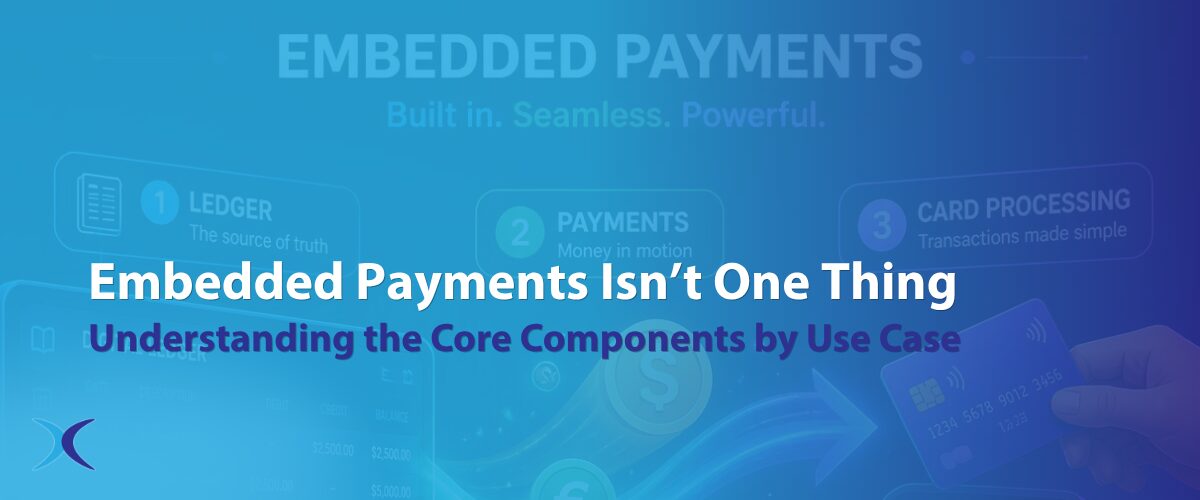
Embedded payments gets used as a single category, but the architecture underneath varies significantly depending on what a platform is actually trying to do. A benefits platform coordinating multi-party settlement has different infrastructure requirements than a vertical SaaS platform adding a single funding rail.
Treating embedded payments as one undifferentiated build leads to over-engineering in some cases and under-engineering in others.
This piece maps embedded payments into distinct architectural components. Then. we will look at why modularity makes it possible to match infrastructure to use case without starting over each time.
Three Architectural Approaches to Embedded Payments
Funding or payment integration only
The platform needs to move money in or out but isn’t managing accounts, issuing reloadable cards, or applying spend rules. This pattern typically covers ACH, wire, or one-time disbursements onto an existing product.
The platform connects to funding rails through APIs and event triggers, without taking on ledger management or card issuance.
Full card issuance
The platform issues its own virtual or physical cards, tied to program-level spend controls, authorization logic, and reconciliation. This is the approach required when a product needs:
- Branded instruments
- Real-time authorization decisioning and/or spend controls
- Multi-party fund management
This approach is common for benefits cards that route across multiple purses and B2B cards with controlled spend categories.
It requires card network certification, BIN sponsorship, and a rules engine that drives authorization behaviors.
Ledger-only integration
The platform needs a system of record for value movement to track balances, entries, and multi-party settlement without issuing a payment instrument.
This approach often fits marketplaces, loyalty and incentive programs, or platforms managing non-monetary value (points, credits) alongside currency.
A programmable ledger tracks the movement; funding and card issuance may sit elsewhere or not exist at all.
Most platforms will map cleanly to one of these as a starting point. Few will stay there.
Where Modularity Comes In for Embedded Payments
The three approaches above aren’t fixed tiers. Instead, they’re starting points.
A platform that begins with funding-only integration to move money between buyers and sellers may, six months later, need ledger services to track multi-party balances as its marketplace model matures.
A benefits platform issuing cards today may need to add BNPL-style structured payments for a new service category tomorrow.
This is where a modular infrastructure model matters more than the specific approach a platform starts with.
Rather than treating card issuance, ledger services, and payment processing as a single bundled product, each is a discrete component that can be adopted independently and combined as needs change:
- Ledger services can operate on their own, tracking balances and entries in real time, or serve as the backbone under card issuance and payment processing.
- Payment processing supports a range of transaction types: ACH, check, wire, card, direct-to-debit. It runs on standard protocols or custom payment files and event triggers that are independent of whether card issuance is in scope.
- Card issuance layers spend controls, authorization logic, and multi-purse rules on top of the ledger.
A shared event stream connects all of it, giving platforms real-time visibility into authorizations, postings, and lifecycle events regardless of which components are active.
The practical effect is that a platform doesn’t have to predict its full infrastructure needs at launch.
It can start with the narrowest slice that solves the current problem, and add components as the product evolves, without a rebuild or a vendor switch.
Why This Matters for Vendor Evaluation
Platforms evaluating a BaaS or embedded payments partner often ask “does this vendor support embedded payments?” as if it’s a single yes/no capability.
A more useful question is which components a vendor offers independently, and whether they’re built to compose together as requirements shift.
A vendor offering only a bundled, all-or-nothing product forces a platform to either over-provision infrastructure it doesn’t yet need, or rebuild when it does.
A modular model with ledger, processing, and card issuance available as separable services on a shared event stream lets the infrastructure grow at the same pace as the product.
Xformative provides modular, cloud-native payments infrastructure — including ledger-as-a-service, card processing, and program management. It allows platforms to adopt what they need now and add components as requirements evolve.
