

- October 7, 2026
- Becky Seefeldt
- 0
The Stack: What's Actually Under the Hood of a Modern Card Program
A card is only the visible layer
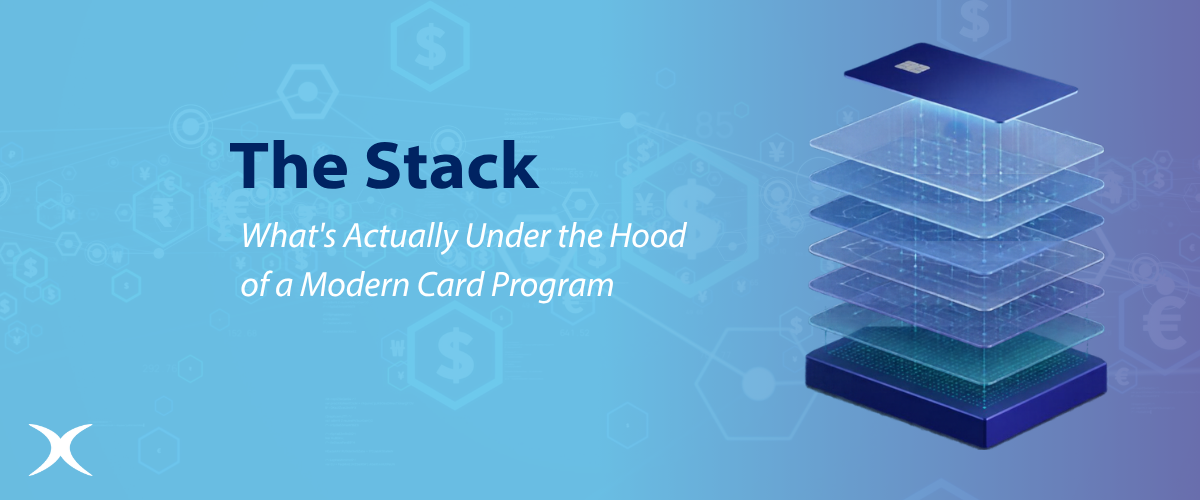
A card program looks simple from the outside. A cardholder taps, the transaction approves, and a balance updates. Underneath that moment sits a stack of infrastructure. Each layer decides something different: who holds the funds, which rules apply, where value is recorded, and how every party sees the result.
Card program infrastructure is the set of systems that issue cards, govern how funds are used, record every movement of value, and report on it in real time. These layers are often discussed one at a time. This piece looks at the full stack, and at what becomes possible when the layers are designed to work together.
Key takeaways
- Card program infrastructure spans seven layers, from the issuing bank and network up to APIs and the event stream.
- The ledger is the system of record every other layer depends on once a program adds purses, funding sources, or restrictions.
- The same stack serves benefits, payroll, lending, and care now, pay later programs; only the configuration changes.
- When evaluating providers, focus on how the layers connect and how much can be configured rather than rebuilt.
The layers, from the bank up
1. The regulated foundation
Every card program starts with an issuing bank and a card network. The bank holds deposits, sponsors the BIN, and carries responsibility for KYC, AML, and program oversight. The network connects the card to merchants and carries authorization and settlement messages. Program owners do not become banks; they operate on top of this regulated core.
2. Issuing and card lifecycle
The issuing layer creates digital and physical cards and manages them through activation, replacement, suspension, and closure. It also coordinates fulfillment and card design. Program owners can work with established partners for network, fulfillment, bank, and BIN relationships, or bring their own.
3. Authorization and rules
When a card is used, the processor has seconds to decide. The rules layer evaluates merchant data, program configuration, and available balances, then approves, partially approves, or declines. Rules can apply at the program, purse, merchant level, and sometimes even individual products (referred to as SKU-level).
4. The ledger
The ledger is the system of record. It tracks balances, debits, credits, holds, and adjustments for every account and purse in real time. A modern ledger is not limited to dollars; it can hold points or other non-monetary values alongside currency, each with its own rules. In a single balance program the ledger is easy to overlook. Once a program adds a second purse, funding source, or restriction, every other layer depends on it.
5. Funding and money movement
Cards spend value, but value has to arrive and leave. This layer moves funds through ACH, wire, check, card, and direct to debit rails, and applies rules to payouts. It connects the program to whoever funds it and to the payees on the other side.
6. Entities and programs
Behind every card is a structure of relationships. An organization model stores the parties involved, such as clients, participants, dependents, and payees, and how they relate. A program model defines the account offerings those parties can hold. This layer is what lets one platform run many programs without rebuilding each one.
7. Data and integration
The top of the stack is how platforms work with everything below it. APIs create accounts, issue cards, and load funds. An event stream publishes authorizations, clears, returns, ledger postings, and lifecycle changes as they happen, replacing end of day files. Sandboxes and reconciliation tools let teams build, test, and close the books from the same data.
What the stack enables
When these layers share one data model, the card becomes a programmable way to deliver value. The capabilities below apply across industries; only the configuration changes.
- Controlled spend. Funds can be limited to eligible merchants, categories, or amounts, supporting benefits accounts, stipends, and purpose specific disbursements.
- Multiple values on one card. Separate purses with separate rules let one credential carry several balances, funding sources, or value types.
- Funding that follows the program. Employers, payroll providers, lenders, and administrators can fund on a schedule, on demand, or by rule.
- Embedded installment access. Lenders and service providers can add network acceptance to installment or care now, pay later programs while keeping their own underwriting and program rules.
- Real time visibility. Every party sees balances and events as they occur, which supports reconciliation and audit requirements.
- Faster iteration. New programs, purses, or rules are configured on existing infrastructure rather than built as separate systems.
Evaluating card program infrastructure
For teams evaluating card program infrastructure, the useful question is not whether a provider can issue a card. It is how the layers beneath the card connect, and how much of the program can be configured rather than rebuilt as requirements change. Xformative’s solutions and developer resources show how these layers fit together on one platform.
FAQs
Card program infrastructure is the set of systems that issue cards, authorize transactions, record balances, move funds, and report activity. It typically spans an issuing bank and network, a processor, a ledger, payment rails. In modern card programs, APIs are often used to provide real-time exchange of data and actions across systems.
The processor decides whether a transaction is approved and handles network messaging. The ledger records the result, maintaining balances and transaction history as the system of record. The ledger can be provided by the processor or be an independent module. The key is ensuring that the processor and ledger exchange real-time data so they are always in sync.
With a typical checking account, you have one account at the bank that is linked to a debit card. A separate ledger is not typically required. For specialty card programs, the bank typically holds funds in aggregate. The ledger tracks how those funds are allocated across individual accounts, purses, and value types, which program rules and reporting depend on.
It can, when the infrastructure is built for complexity. Health and benefits transactions are often considered some of the most complex in the card ecosystem, combining eligibility rules, multiple purses, substantiation, and regulatory requirements in a single authorization. Xformative built its infrastructure to handle those scenarios first, then adapted it to serve other industries with complex payment needs. Basic banking infrastructure designed for single balance accounts does not necessarily transfer in the same way.
