

- November 4, 2026
- Becky Seefeldt
- 0
How Medical Claims Payments Work: Process, Parties, and Common Challenges
A medical claims payment moves through adjudication, funding, disbursement, remittance, and reconciliation, with multiple parties involved at each step. A medical claims payment is rarely a single transfer from one party to another. It is a sequence of decisions, calculations, and fund movements that passes through several systems before a provider is paid and a patient balance is resolved.
Understanding how claims payments move through the stack helps payers, administrators, and platforms see where friction originates. It also clarifies what claims payments infrastructure must support to make that movement accurate, traceable, and compliant.
This article walks through the parties involved, the path a claim payment follows, and the operational pain points that persist across the industry.
Key Takeaways
- A medical claims payment involves multiple parties, rails, and timelines, so it is rarely a single transfer.
- Multiparty flows, timing gaps, adjustments, and paper checks are the most persistent sources of friction.
- Claims payments infrastructure built on a programmable ledger keeps every obligation, payment, and adjustment traceable.
Who is involved in a Medical Claims Payment?
Every medical claims payment touches multiple parties, each with its own systems, obligations, and timelines.
On the care side, the provider delivers services, submits the claim, and receives payment along with remittance detail that explains how the claim was paid. The patient, or member, owes whatever the plan does not cover, such as a deductible, copay, or coinsurance.
On the plan side, the payer adjudicates the claim and determines the allowed amount and its share of the cost. In self-funded arrangements, a third-party administrator (TPA) often handles adjudication and payment on behalf of the plan sponsor, which funds claims and expects clear visibility into what was paid.
Between them sit the systems that carry data and money. Clearinghouses route and format claim and remittance data. Banks and payment rails move funds via ACH, card networks, checks, or wire transfers. A ledger and processing layer records each obligation, payment, and adjustment as the system of record.
The challenge is not any single party. It is the coordination across all of them.
How does a Claims Payment move from submission to reconciliation?
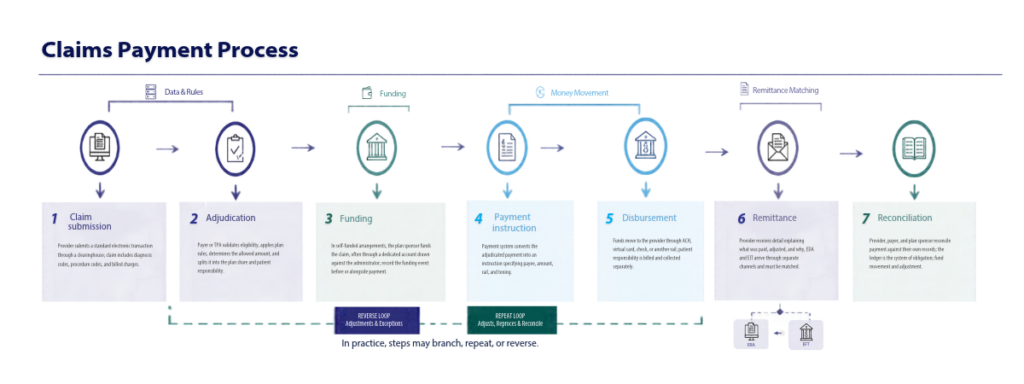
A claims payment follows a defined path from submission to reconciliation. Each layer adds data, applies rules, or moves funds.
- Claim submission. The provider submits a claim, typically as a standard electronic transaction routed through a clearinghouse. The claim carries codes for diagnoses, procedures, and billed charges.
- Adjudication. The payer or TPA validates eligibility, applies plan rules, and determines the allowed amount. It then splits that amount into the plan’s share and the patient’s responsibility.
- Funding. In self-funded arrangements, the plan sponsor funds the claim, often through a dedicated account that the administrator draws against. The funding event must be recorded before or alongside the payment.
- Payment instruction. The payment system converts the adjudicated result into a payment instruction. It determines the payee, the amount, the rail, and the timing.
- Disbursement. Funds move to the provider through ACH, virtual card, check, or another rail. Separately, any patient responsibility is billed and collected.
- Remittance. The provider receives remittance detail that explains what was paid, what was adjusted, and why. Electronic remittance advice (ERA) and the corresponding electronic funds transfer (EFT) arrive through separate channels and must be matched.
- Reconciliation. The provider, payer, and plan sponsor each reconcile the payment against their own records. The ledger serves as the system of record for every obligation, fund movement, and adjustment.
On paper, this sequence looks linear. In practice, several of these steps branch, repeat, or reverse.
Where do Claims Payments break down?
The most persistent friction in medical claims payments comes from four areas: multi-party payments, timing, adjustments, and paper checks.
Multi-party payments
A single episode of care often produces obligations to several parties. A plan pays its share to the provider, the patient owes a remaining balance, and in some cases a secondary payer or an account-based benefit covers part of the cost.
Each of these flows may originate from a different funding source and settle on a different rail. When the systems that manage them are disconnected, no single record shows the full cost of care and how it was paid. Providers and administrators then reconstruct that picture manually.
Timing
Claims payments move on several clocks at once. Adjudication, funding, disbursement, and remittance rarely occur sequentially.
A payment can settle days before or after its remittance detail arrives. Plan sponsor funding can lag behind payment obligations. Batch processing and end-of-day file exchanges add further delays, leaving balances and payment status uncertain between cycles.
Adjustments
Claims are frequently revised after the initial payment. Corrected claims, coordination of benefits, appeals, recoupments, and overpayment recoveries all change what was owed.
Each adjustment must be applied to the original obligation, not recorded as an unrelated transaction. Without that linkage, offsets against future payments become difficult to trace, and reconciliation depends on manual research rather than system records.
Paper checks
Despite broad adoption of electronic standards, paper checks remain part of claims payments. Some providers have not enrolled in electronic payment, some payers default to check for certain payees, and some refunds and patient reimbursements still move by mail.
Checks introduce printing and mailing costs, longer settlement windows, escheatment obligations for uncashed items, and a separation between payment and remittance detail. They also limit visibility into when funds actually leave the account.
What does a modern Claims Payments Infrastructure require?
Addressing these pain points is less about adding another payment method and more about how the underlying stack records and moves value. Claims payments infrastructure built for this environment addresses three areas: how value is recorded, how it moves, and how each party sees it.
Recording value. A programmable ledger serves as the system of record, capturing every obligation, funding event, payment, and adjustment against the entities involved. Reversals, recoupments, and corrected payments reference the original transaction, which keeps the full cost of care traceable and preserves an auditable history.
Moving value. ACH, card, check, and wire are managed from one platform, with rules based payouts determining which rail applies to each payee and payment type. Paper checks remain supported where they are still required, while electronic options stay straightforward to adopt.
Seeing value. Real-time events and webhooks replace end-of-day files, so balances and payment status are current for every party. Built-in reconciliation tooling connects payments to their funding sources and remittance details, reducing manual matching.
At Xformative, these principles inform how we approach ledger services and payment processing for benefits and specialty payment programs: one platform that supports ACH, check, wire, and card, with rules-based payouts and a shared event stream.
Frequently Asked Questions
Claims payments infrastructure is the set of systems that turns an adjudicated claim into completed, reconciled payments. It includes the ledger that records obligations and fund movements, the processing layer that applies payment rules, and the connections to rails such as ACH, card, check, and wire.
Paper checks remain in use when a provider has not enrolled in electronic payment, when a payer defaults to check for certain payees, or for some refunds and patient reimbursements. Reducing check volume depends on provider enrollment and on infrastructure that supports both methods during the transition.
Corrected claims, coordination of benefits, appeals, and overpayment recoveries can change what was owed after funds have moved. Each adjustment should reference the original payment so that offsets, recoupments, and reissued payments remain traceable for every party.
