Cloud First APIs vs APIs Wrapped Around Legacy Systems
Key Takeaways
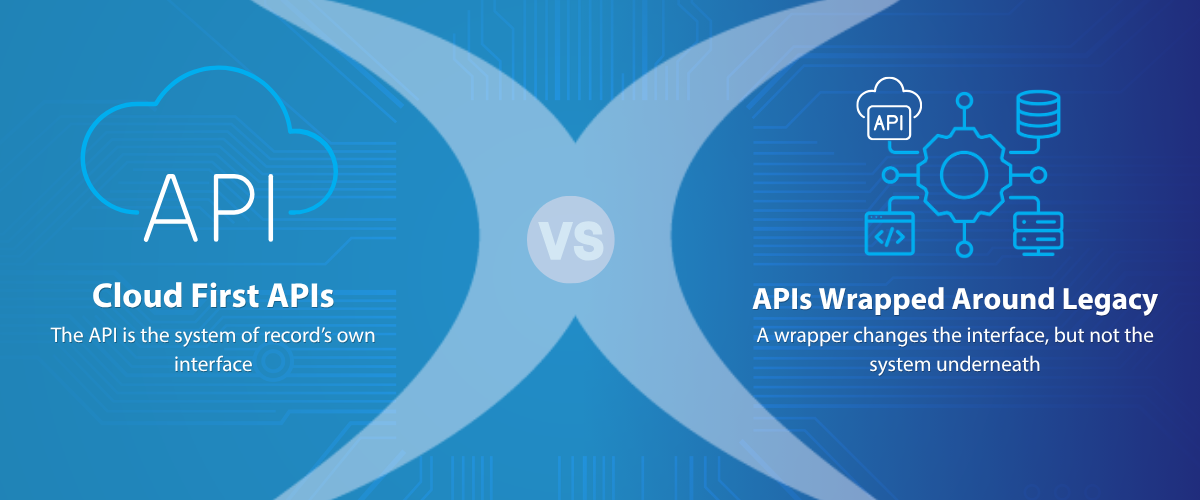
Two APIs can look identical at the endpoint while behaving very differently underneath. What matters is not the shape of the request and response, but what the API is actually calling into.
Cloud native API infrastructure is built for composability from the start: stateless services, well defined contracts, and horizontal scale.
Legacy API integration usually means a translation layer placed in front of a system that was never designed to be queried this way.
The practical differences show up in performance under load, audit trails and data lineage, and maintenance cost.
Two different starting points
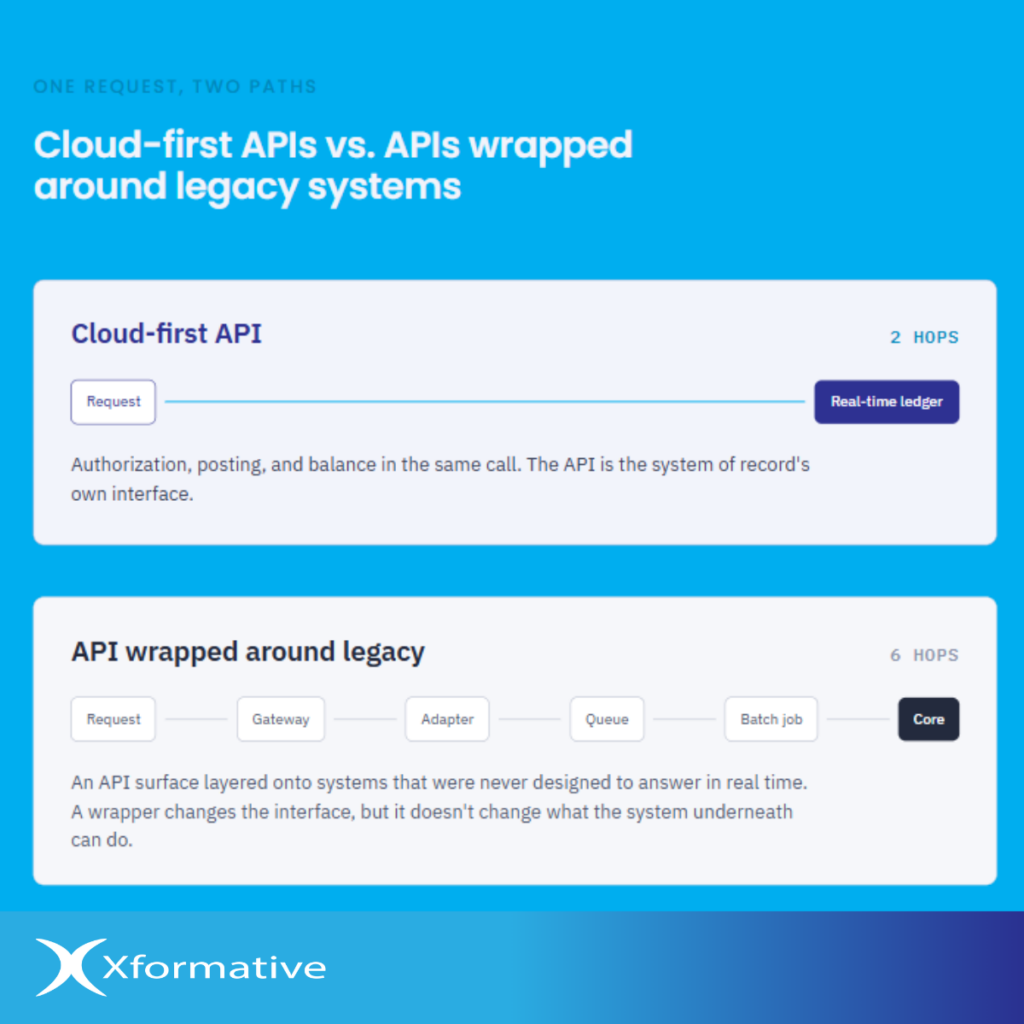
Cloud first API infrastructure is built around composability from day one. Services are stateless where possible, communicate through well defined contracts, and scale horizontally because the architecture assumes concurrent, distributed demand. The API is not a feature added to the system. It is the system’s primary interface. Internal services are designed to be consumed that way.
Legacy API integration follows a different path. A system originally built for batch jobs, scheduled reports, or a single application front end gets a translation layer placed in front of it so it can speak HTTP. The endpoint may look modern. However, underneath it is often calling into stateful processes, tightly coupled modules, or systems that were never designed to handle concurrent request patterns. The API becomes a wrapper around behavior the core system was never built to expose.
Where the difference actually shows up
The gap between cloud native API infrastructure and a legacy API wrapper is easiest to see in three places.
1. Performance under load behaves differently.
Cloud native services are typically designed to scale out, adding capacity horizontally as demand increases. Legacy cores wrapped in an API often scale vertically at best, and the translation layer itself can become a bottleneck since it has to reconcile modern request patterns with an older processing model.
2. Failure modes differ.
A cloud native architecture is generally built with graceful degradation in mind. Individual services can fail without taking down the whole system. When a legacy core fails behind an API wrapper, the failure often cascades back through the translation layer, because the wrapper depends entirely on the health of the system it was built to expose.
3. System maintenance, cost efficiency and resource availability.
Maintenance, cost efficiency, and resource availability follow the same pattern. Cloud native APIs evolve through versioning practices built into the architecture, and maintenance stays contained to a single, coherent system. Legacy API integration requires maintaining the wrapper and the underlying system in parallel, and every change to the underlying system risks breaking the translation layer, whether or not that layer was touched.
Cost efficiency tends to follow suit. Cloud native infrastructure can rely on pay as you go compute and storage that scale with actual usage, while a legacy wrapped API often still requires maintaining the legacy system’s infrastructure alongside the new wrapper, which means paying for both.
Developer experience tends to diverge as well. A cloud native API can be designed around clean, consistent resource models and versioning from the outset, while a legacy wrapper often inherits inconsistent naming, unusual data shapes, or quirky business rules from the underlying system. Those quirks leak through the API and make it harder for API consumers to reason about and slower to build against.
Why this matters for regulated environments
There is also a compliance dimension that is easy to overlook. Audit trails and data lineage are often native to cloud first systems, because the architecture was designed with observability and traceability built in from the start. A legacy system with an API wrapper frequently lacks that same visibility underneath. Typically, the original system predates modern logging and lineage standards. The wrapper can expose data without necessarily exposing where that data came from or how it moved. This is a real gap in regulated industries where the origin and tracability are essential.
What this means when evaluating infrastructure
Neither approach is automatically wrong. Not every organization can or should rebuild a legacy core simply to make it cloud native. A well built API layer extends the useful life of a system that still does its job. The point? Don’t treat every API as equivalent because it exposes the same shape of request and response.
The more useful questions are:
What sits behind the endpoint?
Is the system designed to be queried this way?
Is the system being asked to behave in a way it was not intended to?
The distinction shapes performance, resilience, maintenance cost, and compliance posture in ways that are not visible from the API documentation alone.
It only becomes visible under load, during a failure, or during an audit, which is exactly when the difference matters most.
About Xformative’s Cloud First API Infrastructure
Xformative is a cloud native, API first financial infrastructure company built to modernize how value moves across benefits, payments, and specialty financial programs. Founded in 2016, the platform was designed around composability and real time control from the outset, rather than assembled by layering an API onto an existing processing core.
Configurable ledgering, card issuance and processing, program management tooling, compliance and governance, and data and reporting are each exposed through modern APIs. Those APIs were part of the architecture from day one, not added later. Organizations can adopt individual components without committing to an all or nothing platform. They also get visibility into how value moves through the system in real time, rather than relying on batch based reporting after the fact.
Becky Seefeldt partners with Xformative as a Fractional Chief Marketing Officer, bringing more than 20 years of experience across benefits, payments, and compliance‑driven industries. She is an active member of the Forbes Business Council and a published contributor to SHRM, BenefitsPro, Employee Benefit News, TalentCulture, and HR Morning. Becky was honored as a BenefitsPRO Luminary for her leadership in benefits communication and education.