

- September 28, 2026
- Becky Seefeldt
- 0
Built For Buy Now Pay Later: Why Installment Servicing is a Ledger Problem, Not Just a Lending Problem
A practical look at why buy now pay later programs depend on the ledger layer as much as the credit decision
Buy now pay later (also referred as BNPL) is usually discussed as a lending product. The conversation often centers on approval rates, underwriting models, and credit risk. While those factors matter, once a plan is approved, the program shifts from lending to servicing. Servicing is a recordkeeping discipline. Every scheduled payment, refund, adjustment, and merchant settlement changes what is owed, by whom, and to whom.
This post looks at why BNPL ledger infrastructure deserves the same design attention as the credit model, what an installment ledger actually has to track, and where programs built on simple balance tracking tend to run into trouble.
Key Takeaways
- The credit decision happens once. The ledger must account for every event that follows.
- Installment servicing requires tracking principal, payments, fees, adjustments, and settlement as distinct but connected values.
- Partial refunds, returns, and failed payments are ledger events first.
- Xformative’s configurable, multi-purse ledgering gives BNPL programs a single system of record for how installment value moves and is reconciled.
The Credit Decision is One Event. Servicing is Everything After it.
Consider a single purchase split into four installments. The one purchase or plan generates an origination entry, merchant funding, an initial payment, and at least three scheduled payments. Then, you have possible payment retries, fees, and refunds. Each of those events has to post to the right account, in the right amount, in the right order.
Now multiply that across a portfolio where thousands of plans or purchases sit at different stages. Lending logic answers whether a plan should exist. The ledger answers what state that plan is in right now, and whether every party to it is working from the same numbers.
What a BNPL Ledger has to Track
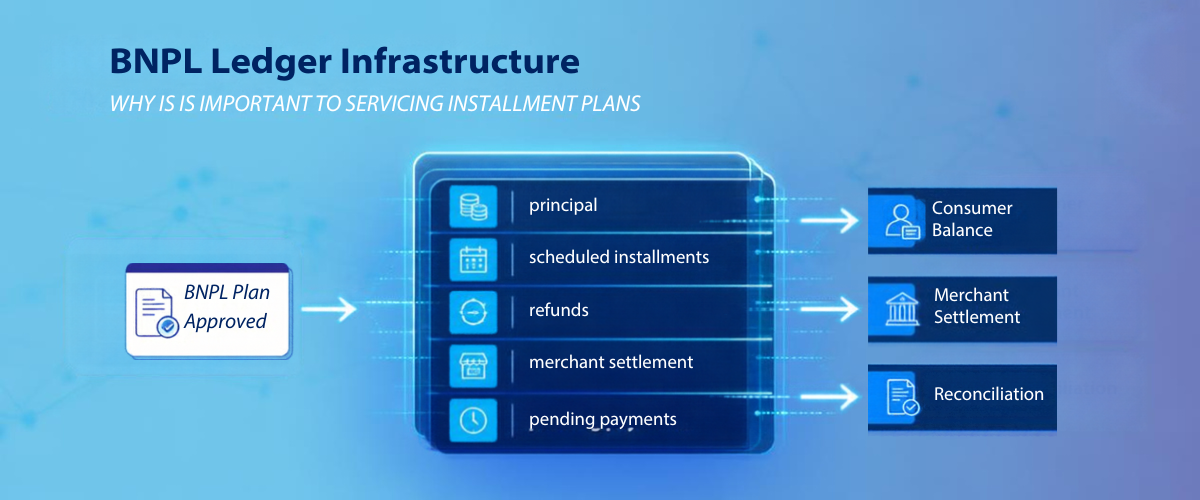
Installment servicing requires the ledger to hold several categories of value separately while keeping them linked to the plan that created them:
- Outstanding principal: the remaining balance on each plan, kept distinct from the consumer’s total obligations across multiple plans.
- Scheduled installments: the amount, due date, and current status of each payment in the schedule.
- Payment application: how each received payment is applied, including which installment it satisfies and how it is allocated across principal and any fees.
- Merchant settlement: the value owed or paid to the merchant, net of whatever fee structure the program defines.
- Pending activity: authorizations that have not yet cleared and bank payments that have been initiated but not yet settled.
- Adjustments: refunds, returns, disputes, and waivers, each tied back to the originating plan and transaction.
None of these can be collapsed into a single running balance without losing information the program will later need.
Where Simple Recordkeeping Breaks
Many programs start with one balance per customer. The approach works when activity is predictable. However, ledger requirements often surface during servicing events.
Service events where the BNPL ledger infrastructure matters
- Partial returns: A customer returns part of a purchase after two installments have been paid. Should the refund reduce the remaining installments, shorten the term, or return funds to the customer? These are program decisions. But, the ledger has to execute it correctly and preserve an audit trail showing how and why the balance changed.
- Splitting payments across plans: A customer with several active plans makes one payment larger than any single installment due. The ledger needs a defined rule for which plan receives the funds and in what order.
- Bank returns: A bank payment is returned days after the installment was marked as paid. The ledger has to reverse that posting, restore the installment to an unpaid status, and apply any program rules that follow.
- Merchant returns for fully paid plans: A merchant processes a return after the merchant has already been funded. The ledger has to record the offsetting value on the merchant side as well as the consumer side.
None of these are credit questions. A program with a weak ledger ends up absorbing these events through manual adjustments and reconciliation. Customer service is challenged when the displayed balance doesn’t match what the customer believes they owe.
Why Specialized Programs Demand Higher Precision
Installment programs increasingly operate in settings such as healthcare, where care-now-pay-later models support patient financing, and in specialty retail and services. Consumer credit programs are generally subject to disclosure and statement requirements. Additionally, bank partners and auditors expect each balance to be traceable to the events that produced it. Meeting those expectations requires a ledger that records each event as it happens, rather than reconstructing balances after the fact.
How Xformative Approaches BNPL Ledger Infrastructure
Xformative treats the ledger as the system of record for the program rather than a byproduct of the lending system. Its configurable, multi-purse ledgering allows plan balances, scheduled obligations, and related program value to be held as distinct, rules-governed purses within the same account structure.
Authorization and clearing are handled as separate, observable events, which keeps holds and pending activity accurate as transactions move toward settlement. Returns and reversals can be applied back to the originating purse, preserving the connection between an adjustment and the plan it affects. The Ledger API gives program teams direct access to accounts, entries, and posting fund flows, and each customer’s event stream provides visibility into every event that has occurred.
Program rules are defined per program rather than hard-coded, so a lender can set how refunds, payment application, and adjustments behave without custom engineering work. The lender keeps ownership of its underwriting and credit policy. Xformative operates as the infrastructure layer alongside the bank and network relationships the program depends on.
If your organization is building or scaling an installment program and evaluating how its servicing logic is recorded, Xformative’s team can walk through how configurable ledgering and program management apply to your specific requirements.
FAQs
BNPL ledger infrastructure is the system of record that tracks every financial event in an installment program after the credit decision. This includes outstanding principal, scheduled payments, fees, refunds, and merchant settlement. It determines the current state of each plan and keeps every party working from the same balances.
A loan management system typically focuses on the credit side of the relationship: origination, terms, and repayment schedules. A BNPL ledger records how value actually moves across the consumer, the merchant, and the program. It also covers holds, pending payments, reversals, and adjustments tied to specific transactions. Many programs need both, and the ledger is what keeps servicing activity accurate between them.
The program defines the rule. A partial refund might reduce the remaining installments, shorten the term, or return funds to the customer. The ledger’s role is to execute that rule consistently, link the refund to the originating plan and transaction, and preserve an audit trail showing how the balance changed.
Yes. Ledger infrastructure governs how value is recorded and moved, not who approves credit. With Xformative, the lender keeps ownership of its underwriting and credit policy. Xformative operates as the infrastructure layer alongside the program’s bank and network relationships.
