

- September 17, 2026
- Becky Seefeldt
- 0
How Multi-Purse Card Programs Work: One Card, Multiple Spending Categories
The Single Balance Problem
Most card programs start with a simple assumption: one card, one balance, one set of rules. The model works until a program needs to separate funds by category, funding source, or eligibility requirement. A benefits program that funds medical, dependent care, and commuter expenses cannot run all three through a single balance and meet IRS requirements. Once a program needs that separation, the infrastructure question becomes unavoidable. How does one card know which balance to use, and when?
What is a Multi-Purse Card Program?
A purse is a distinct balance, or subledger, tied to a single card. A multi-purse program links several of these purses to one card number. Each purse may carry its own funding source, spend rules, and eligibility criteria. This is ledger-level infrastructure, not a wallet interface layered on top of a card. The card number stays constant. What changes, transaction by transaction, is which purse gets debited and under what conditions.
Key Takeaways
- A multi-purse card program links one card number to multiple distinct balances, each with its own funding source and spend rules.
- Category eligibility is evaluated at the point of authorization, using merchant category codes, item-level validation, and program rules, not corrected after the fact.
- When more than one purse could fund a transaction, a configurable rules engine determines priority and fallback order.
- Ledger infrastructure, not the card itself, is what makes multi-category spend auditable and compliant.
- Programs that start with a single balance often discover the need for purse-level segmentation only once spend categories, funding sources, or eligibility rules multiply.
How it Works: The Underlying Mechanics
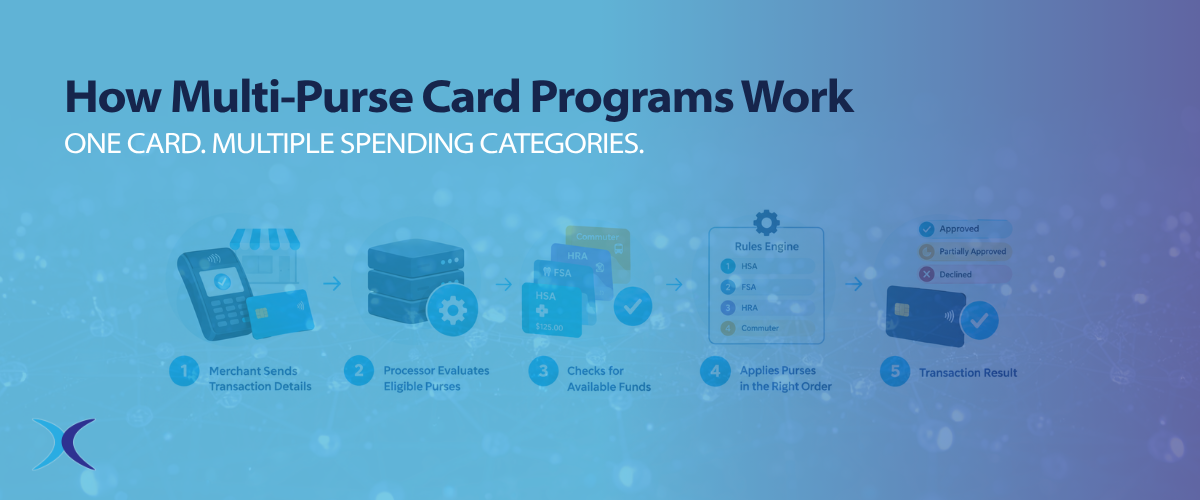
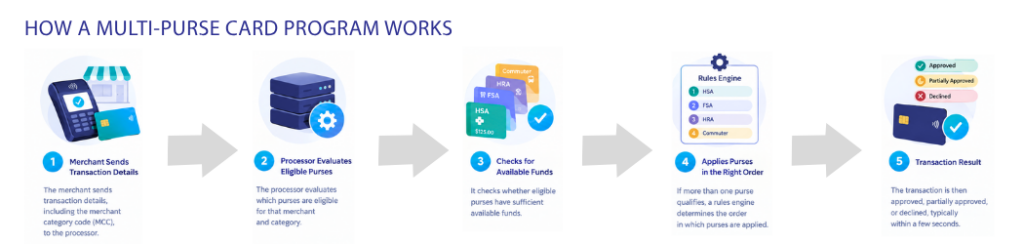
Every authorization follows a predictable, configurable sequence. The merchant sends transaction details, including the merchant category code, to the processor. The processor evaluates which purses are eligible for that merchant and category. It checks whether eligible purses have sufficient available funds. If more than one purse qualifies, a rules engine determines the order in which purses are applied. The transaction is then approved, partially approved, or declined, typically within a few seconds.
Authorization and clearing are treated as separate, observable events in this model. Authorization is the real-time decision to approve or decline based on rules, balances, and network data. Clearing is the later message that finalizes the transaction amount and moves funds through the network to the merchant. Modern processors track both events independently. This allows purse balances to update in real-time rather than waiting for end-of-day settlement files. This enables accurate multi-purse decisioning and limits risk of overspending.
Managing Multiple Spending Categories on One Card
Category eligibility starts with the merchant category code, which identifies the type of merchant, such as a pharmacy, dentist, or transit provider. Administrators can configure MCC allowlists, blocklists, and program-level rules that map categories to specific purses.
MCC alone is not always sufficient, particularly at merchants that sell a mix of eligible and ineligible items. For those cases, item- level validation through the Inventory Information Approval System, or IIAS, checks individual items in a cart against IRS eligibility rules. Eligible items are charged to the appropriate benefits purse. Ineligible items may route to an open purse on the same card (if applicable) or to another payment method in the same transaction, a process known as split tender.
When a purchase qualifies against more than one purse, priority and fallback logic determine the order of operations. Administrators can define purse priority, such as applying an FSA before an HRA, set conditional logic for specific scenarios, and configure fallback rules for mixed eligibility purchases. This sequencing happens before authorization completes, not as a manual reconciliation step afterward.
Why This Matters for Program Design
Purse-level segmentation reduces the overhead of issuing separate cards for each benefit or spending category. It also creates a cleaner audit trail, since funds are segmented and tracked at the ledger level rather than reconstructed from settlement data. Categories and rules live in configuration rather than in the physical card. This means programs can add or adjust spending categories without reissuing cards to every member.
It also improves the member experience. Members do not need to carry multiple cards or think about which one to use. A single card can seamlessly pull from the appropriate purse based on the rules behind it.
Where Multi-Purse Infrastructure Applies
Multi-purse ledgering supports any program that needs to separate funds by source or use case on a single card. Common categories include health and welfare benefits, fleet and expense programs, and programs that combine multiple funding sources under one card product. The underlying mechanics, MCC evaluation, item-level validation where needed, and rules-based purse sequencing remain consistent regardless of the specific categories a given program defines.
What to Ask When Evaluating a Multi-Purse Capability
Programs considering a multi-purse card should ask their processor or platform partner a few direct questions:
- How is authorization affected when multiple purses and rules must be evaluated before a decision is returned? Is there a maximum number of accounts that may be offered?
- Does the processor sync in real-time at authorization with the ledger, or are batch processes used to update balances at the time of settlement?
- How configurable is the rules engine? Can purse priority and fallback logic be changed easily? How quickly can new programs and categories be added?
- What level of detail is available per purse? How are returns and reversals applied to the originating purse?
- Does the platform support item-level validation for mixed merchants, or only merchant-level category checks?
These questions surface whether a platform treats multi- purse support as a core ledger capability or as a workaround layered on top of a single balance system.
Learn More About Xformative’s Multi-Purse Card Program Support
Xformative helps card programs design and operate multi-purse capabilities that support distinct balances, configurable spend rules, real-time authorization decisions, and detailed ledger-level reporting. To see how Xformative can support your multi-purse card program, request a consultation.
